
Meet Gabe Wright: The Power of Empathy
Alumni Spotlight

An Ivy League student, active community volunteer, and avid athlete who “played every sport under the sun,” Gabe Wright (Class of 2016) needed a strong work ethic, independence, and a natural curiosity about the world around him to keep everything in balance during college. A graduate of the University of Pennsylvania and now a first-year law student at Temple University in Philadelphia, Gabe can trace some of those qualities back to his kindergarten classroom at the Waldorf School of Atlanta. From story time to folding laundry, he remembers how WSA helped shape him, from an early age, into the person he is today.
Gabe also sees the way that Waldorf education played a role in shaping his empathetic nature. As an active volunteer with various youth organizations in Atlanta and Philadelphia, he has had an impact on many — work he strives to continue as a lawyer. “Being taught empathy at a young age has benefited me greatly,” he tells us. “I see it every day in my life.”
We talked to Gabe about what allowed him to succeed in college, what led him to law school, and what he remembers about his years at the Waldorf School of Atlanta.
How did you balance your busy life as an athlete, a community volunteer, and an undergrad student at the University of Pennsylvania? What qualities allowed you to succeed?
A strong work ethic. Making sure that even when you don't understand, or you don't really want to do the work, you have the discipline to keep pushing through. Eventually things will click. And if you love to read and write, then it'll be easy to maintain your academics too.
The other thing is maintaining a curious mind. In my history classes, for example, I've always imagined that it is a story we’re learning—the story of America, the story of international politics. If you have a creative way of thinking, it awakens the child inside of you and you can connect to the work through the story.
Can you connect these qualities back to your experience in Waldorf education?
Oh, definitely. A lot of Waldorf education centers around listening to stories. Being able to focus on a single story for a long period of time is a dying practice. A lot of people are so focused on moving from subject to subject that their mind is all over the place. If you're able to focus on one subject at a time, because you're genuinely interested in it, that's an advantage.
Waldorf teachers do a great job—and the curriculum does a great job—of making sure that we have the skills to succeed independently. In kindergarten, our teacher would assign us tasks. So you have five-, six-, seven-year-olds learning how to do household activities like sewing, washing dishes, and cooking. Those skills are transferable to when you're on your own in a college environment.
A lot of the people I meet don't know how to do their own laundry or cook for themselves. But those are the sort of things that Waldorf students have been doing since they can remember.
It’s amazing to think that you can link some of your success in college to things you were doing in kindergarten.
Yes, exactly. It's amazing to me. But if you think about it, the foundation of our life really is when we are 4 to 18 years old. When it's cultivated properly, with love and attention, it will be very, very beneficial to you in the future.
How did you find your calling as a lawyer? Why have you chosen this career path?
I had my first introduction to law through my grandfather, who also pushed me to start at the Waldorf school. I have always tried to do a good job of helping other people. And there's no better way than a legal career. And while I might not have been the best writer growing up, I knew that I liked to write and I liked to read. And those are things I have learned to do on a daily basis at a high level.
Did your Waldorf education help you have confidence to do something, like writing, even when you found it challenging?
Yes. My teacher Mr. Smith would always tell me how to improve my writing. He helped me to see where I could do better. Waldorf teachers do a really good job of making sure that the student-teacher connection is strong so that you have the confidence to fail and then continue to try again. I appreciate that. Now I feel like I am a good writer.
What are some of your favorite memories from lower school and middle school?
When you grow up with the same class, and it's a smaller class, you can see the development in real time. We all knew each other very well. Being able to spend time with each other on class trips, in a setting different from the classroom, was always really special. And we all loved being outside at Waldorf. That was the best as a kid.
The Waldorf school really was a big family—even across grades and across ages, we all keep in touch today. It’s awesome, because we really did form each other's characters for such a big period of our lives.
Were the arts and music a part of your life as well?
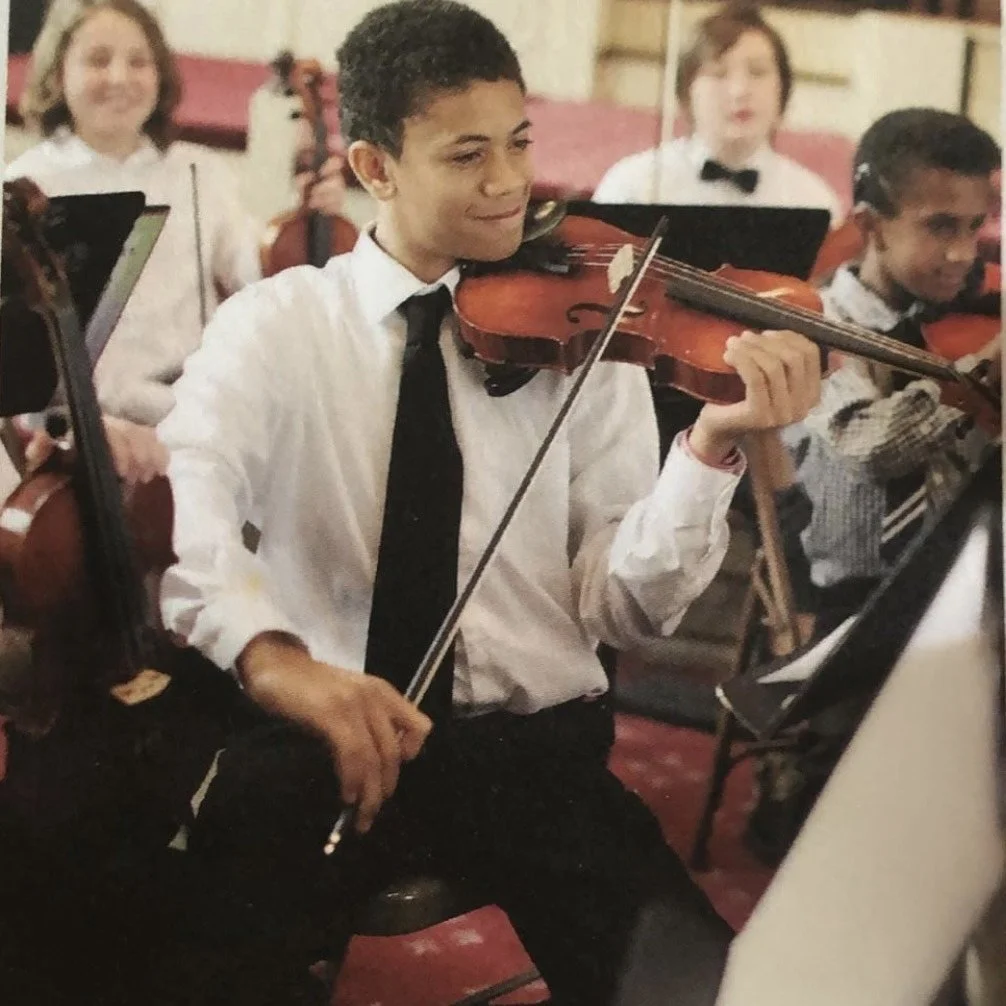
Yes. That brings back memories! I was the first chair in the orchestra in my 8th grade year. I played guitar. After Waldorf, I was part of the All-State Honors Chorus throughout high school, which you had to audition for with all the high school choirs or choruses in Georgia. I had such a full background in Waldorf that reading music, learning music, interacting with other people, and learning how to sing with them - was easy for me.
Those experiences are invaluable. If you know how to make music, even when there’s nothing else around you, you’ll never be bored, you’ll never be unhappy.
Do you still play music?
I’m trying to get into the drums a little bit more, and I’d like to pick up the guitar again. But I think most of the time I'm reading honestly!
Are there other ways you still see Waldorf education in your life today?
The friendships. I think Waldorf kids are empathetic on a deeper level. I don't know if it's because of the class sizes or because of how the teachers talk to the students, but I feel able to recognize when other people are in distress, or when they're uncomfortable. Not everyone has those skills, but they're cultivated so frequently in the Waldorf curriculum that it just seems natural to me.
They say people won't remember anything about you except for how you made them feel. I feel like I am able to show people that I care about them. Being taught empathy at a young age has benefited me greatly. I see it every day in my life.